

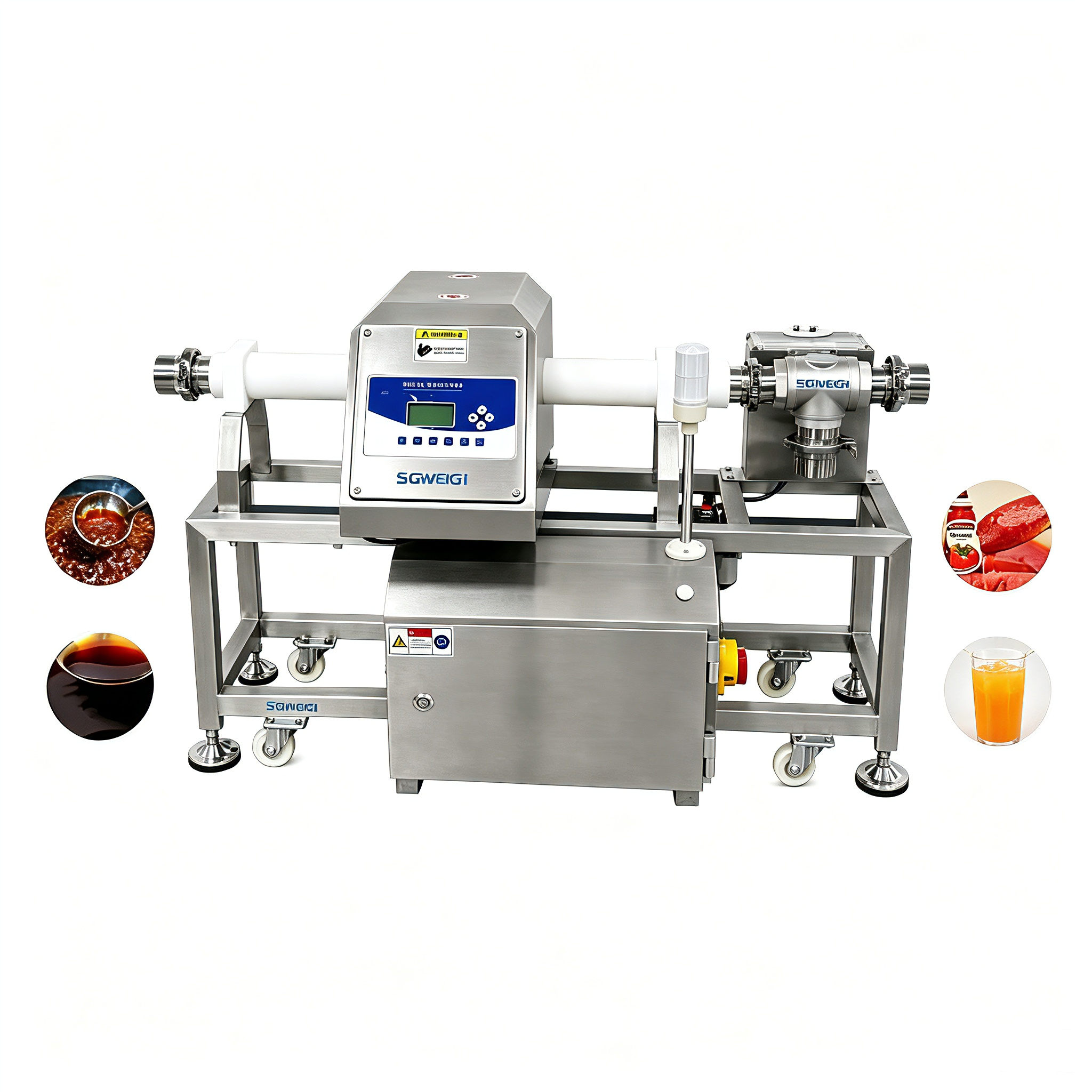

How Does a Hard Capsule Checkweigher Achieve High-Speed 100% Weight Inspection Without Compromising Accuracy?
Hard capsule checkweighing is no longer simply a matter of placing capsules on a scale and sorting them by weight. At high production speeds, the real engineering challenge is to obtain a stable measurement from very small individual loads while maintaining product separation, synchronized transport, reliable rejection, and traceable process data.
For manufacturers evaluating a hard Capsule Checkweigher, the critical question is therefore not only “How accurate is the weighing sensor?” but also “How does the complete dynamic weighing system control the measurement uncertainty under production conditions?”
A modern hard capsule checkweigher is essentially an automatic catchweighing system: it automatically weighs discrete individual loads and classifies them according to their measured mass. OIML R 51 defines a checkweigher within this family of automatic weighing instruments and establishes metrological and technical requirements for applicable checkweighing systems.
Why Is Dynamic Weighing of Hard Capsules More Difficult Than Static Weighing?
A static laboratory balance can allow the object to settle before recording a stable result. A production-line capsule checkweigher has almost the opposite operating condition: the capsule is moving through a weighing channel and must be measured within a very short time window.
The measurement result is consequently influenced by much more than the nominal load-cell resolution.
A useful engineering model is:
Measured Weight = True Capsule Mass + Measurement Error
where measurement error can include mechanical vibration, airflow, capsule position, transport instability, electrical noise, sensor drift, and timing errors.
This is particularly important for hard capsules because their individual mass is relatively small. A small absolute error can therefore become a significant percentage of the target weight.
The weighing mechanism must therefore create a controlled measurement environment through:
stable product spacing → controlled weighing position → rapid stabilization → signal filtering → decision algorithm → synchronized rejection
This is why a professional capsule checkweigher should be evaluated as a complete dynamic measurement system, rather than simply by the advertised sensor resolution.
How Does a Multi-Lane Capsule Checkweigher Increase Throughput?
One of the most effective approaches to high-speed capsule inspection is parallel weighing.
Instead of forcing every capsule through one weighing channel, a multi-lane system distributes capsules across multiple independent or independently monitored channels. Each lane can perform the same fundamental sequence:
- Capsule enters the weighing zone.
- Capsule is isolated from adjacent capsules.
- Dynamic weight signal is acquired.
- Measurement is processed against preset limits.
- The control system identifies pass/fail status.
- The capsule is directed to the appropriate outlet.
This architecture allows manufacturers to increase throughput without simply increasing the mechanical speed of one weighing channel.
The principle is important because increasing conveyor speed alone can make dynamic weighing more difficult. Parallelization provides another way to increase production capacity while retaining a practical measurement window.
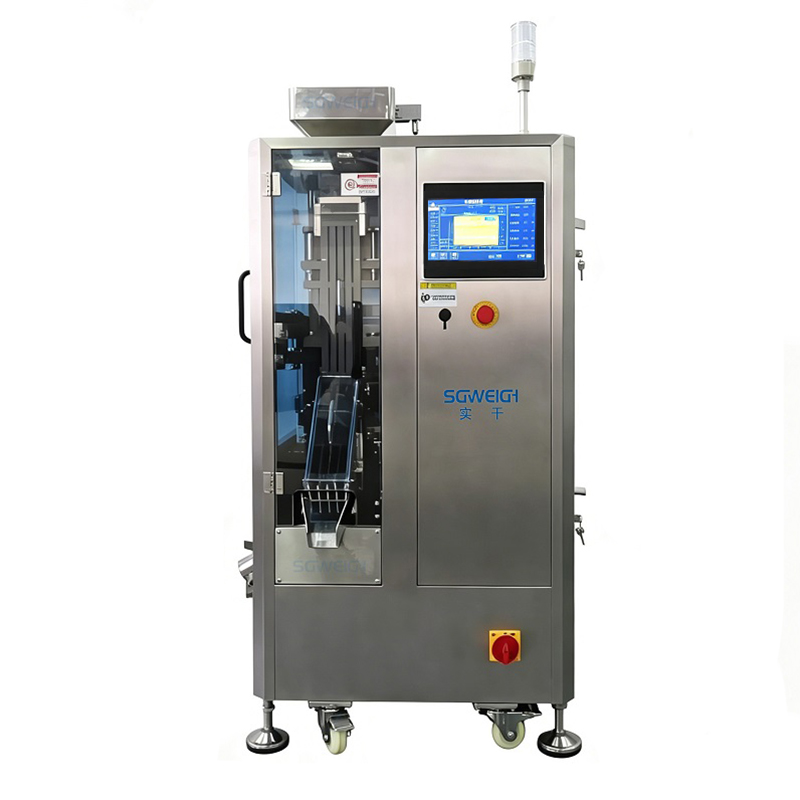
Commercial capsule checkweighing systems demonstrate how this concept is implemented in industry, with multi-lane configurations designed for high-speed individual capsule inspection.
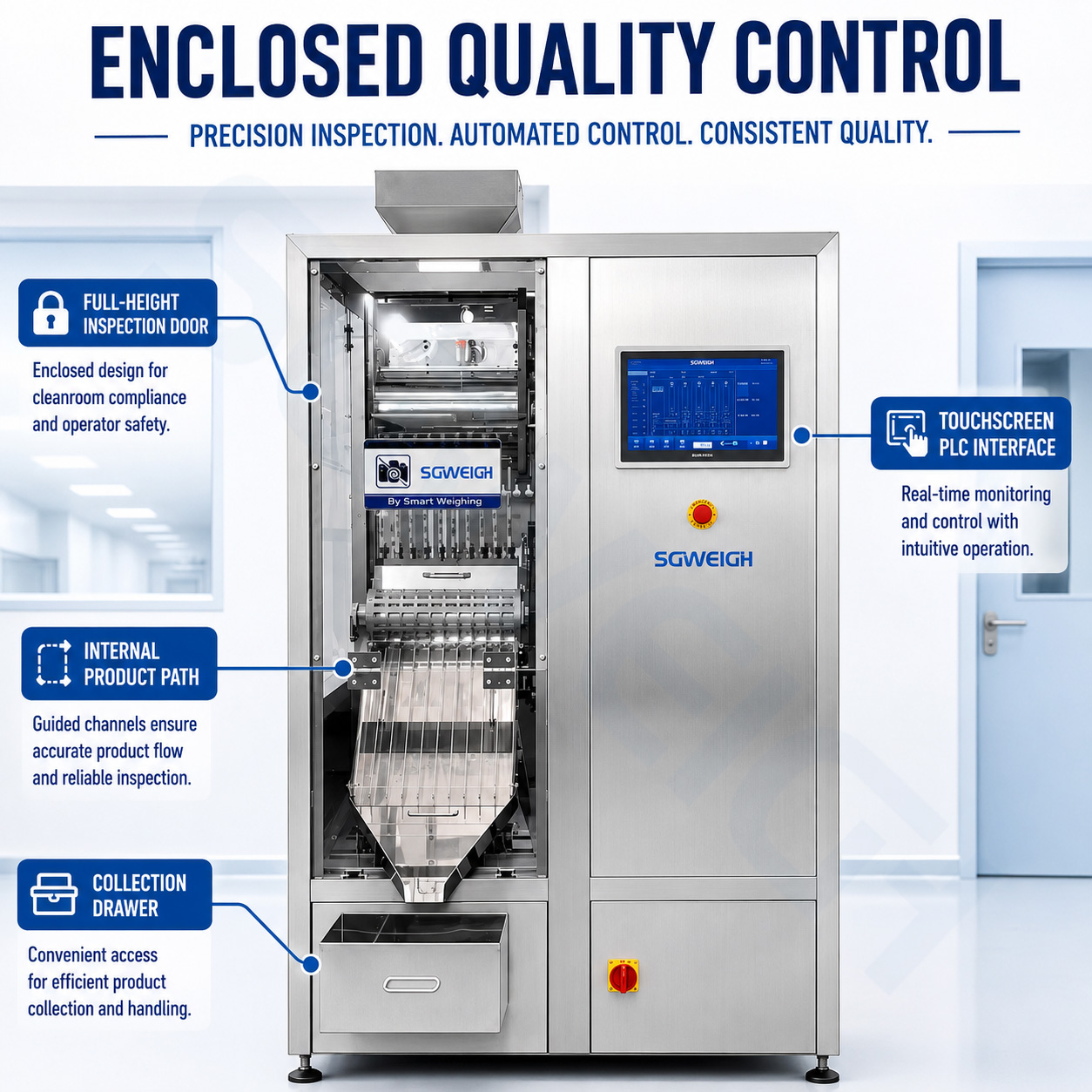
Can a Hard Capsule Checkweigher Perform 100% Inspection?
Yes—provided that the machine architecture, product handling system, measurement performance, and rejection mechanism are appropriately designed and validated for the intended application.
There is an important distinction between 100% in-line weight inspection and pharmacopoeial uniformity testing.
A capsule checkweigher can measure each individual capsule passing through the production line and classify it according to predefined weight limits. This is a manufacturing process-control function.
USP General Chapter <905>, however, addresses uniformity of dosage units, including Content Uniformity and Weight Variation under specified conditions. The pharmacopoeial test is not simply equivalent to running every capsule through an in-line checkweigher. For hard capsules, USP identifies conditions under which the Weight Variation procedure may be applicable.
This distinction is technically important:
A capsule checkweigher is a process-control and inspection tool; it does not automatically replace every laboratory or pharmacopoeial quality-control test.
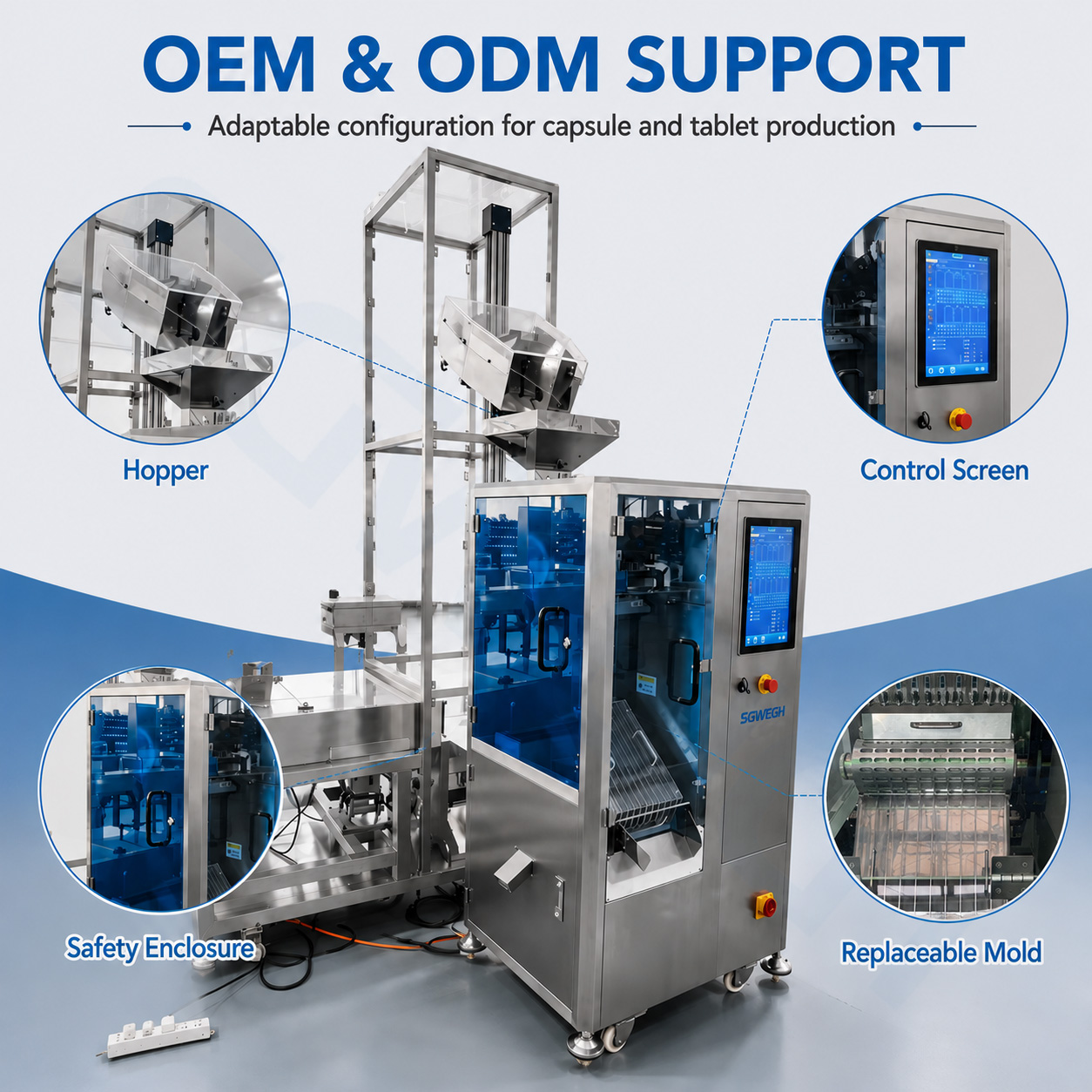
What Causes False Rejects in High-Speed Capsule Checkweighing?
One of the most overlooked technical issues is that high nominal accuracy does not automatically mean high production yield.
False rejects can occur when the measurement system becomes sensitive to normal production disturbances.
Typical causes include:
Mechanical vibration
Nearby motors, conveyors, feeders, or structural resonance can introduce disturbances into the weighing signal.
Unstable capsule spacing
When two capsules enter the weighing zone too closely together, the dynamic signal can become difficult to interpret.
Air movement
Lightweight products are more susceptible to airflow than heavy packaged products. Protective covers and appropriate machine enclosure can therefore improve measurement stability.
Capsule orientation and position
The position of the capsule relative to the weighing element can influence dynamic measurement behavior.
Recent OIML technical work specifically notes that the weighing performance of automatic catchweighers can be affected by the shape of the product and the position of its center of gravity, reinforcing the importance of testing with representative production products rather than relying only on idealized test loads.
Incorrect timing
The system must synchronize product detection, weighing acquisition and reject actuation. Even an accurate measurement becomes useless if the wrong capsule is rejected.
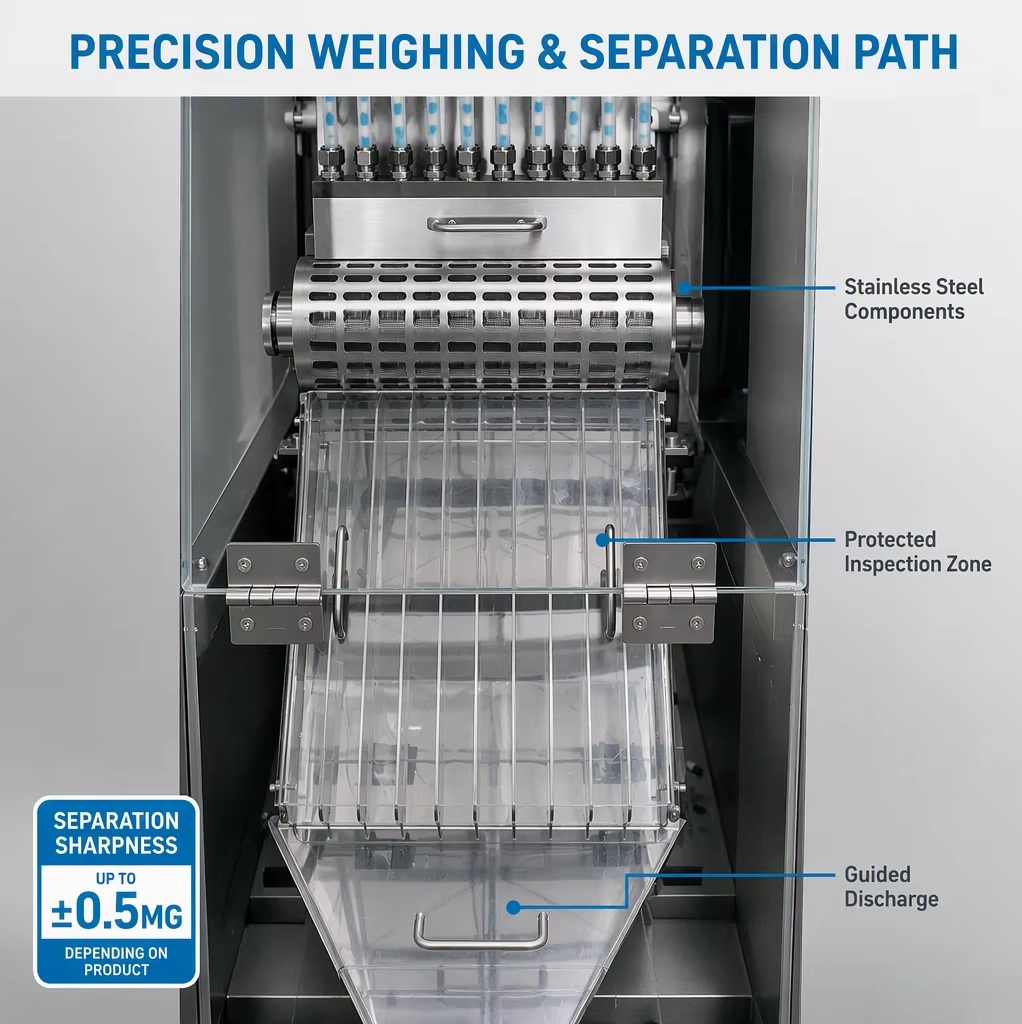
How Should Capsule Checkweigher Accuracy Be Evaluated?
This is where technical specifications need to be read carefully.
A specification such as ±0.5 mg can be meaningful, but accuracy should not be interpreted independently from the conditions under which it was obtained.
A technically meaningful evaluation should consider:
Product mass range
Target tolerance
Production speed
Number of lanes
Sampling and filtering methodology
Actual product geometry
Environmental conditions
Calibration/verification procedure
Reject synchronization
Repeatability over a production run
OIML R 51 provides metrological and technical requirements and test procedures for applicable automatic catchweighers, illustrating why performance should be evaluated under defined test conditions rather than by sensor resolution alone.
Does a Capsule Checkweigher Need Calibration or Verification?
Absolutely.
A high-precision weighing system is not a “set and forget” machine.
The weighing system should have a controlled program for calibration, verification, maintenance and change management appropriate to its intended use.
A robust qualification strategy may include:
Installation Qualification (IQ)
Confirming that the equipment is installed according to approved specifications.
Operational Qualification (OQ)
Demonstrating that the equipment operates correctly across defined operating ranges.
Performance Qualification (PQ)
Demonstrating that the system performs consistently using the actual production process and representative product.
For regulated manufacturing environments, process validation is expected to be based on scientific understanding and appropriate lifecycle controls. FDA’s process validation guidance describes a lifecycle approach to validating manufacturing processes.
For an automatic checkweigher, that means the manufacturer and user should establish objective evidence that the complete measurement-and-rejection system performs as intended.
Why Is the Reject System Just as Important as the Weighing System?
A capsule checkweigher does not create quality control simply by measuring weight.
The final quality decision depends on the entire chain:
Detection → Weighing → Classification → Timing → Rejection → Confirmation
Suppose the system correctly identifies an overweight capsule but the reject actuator fires too early. The wrong product may be removed.
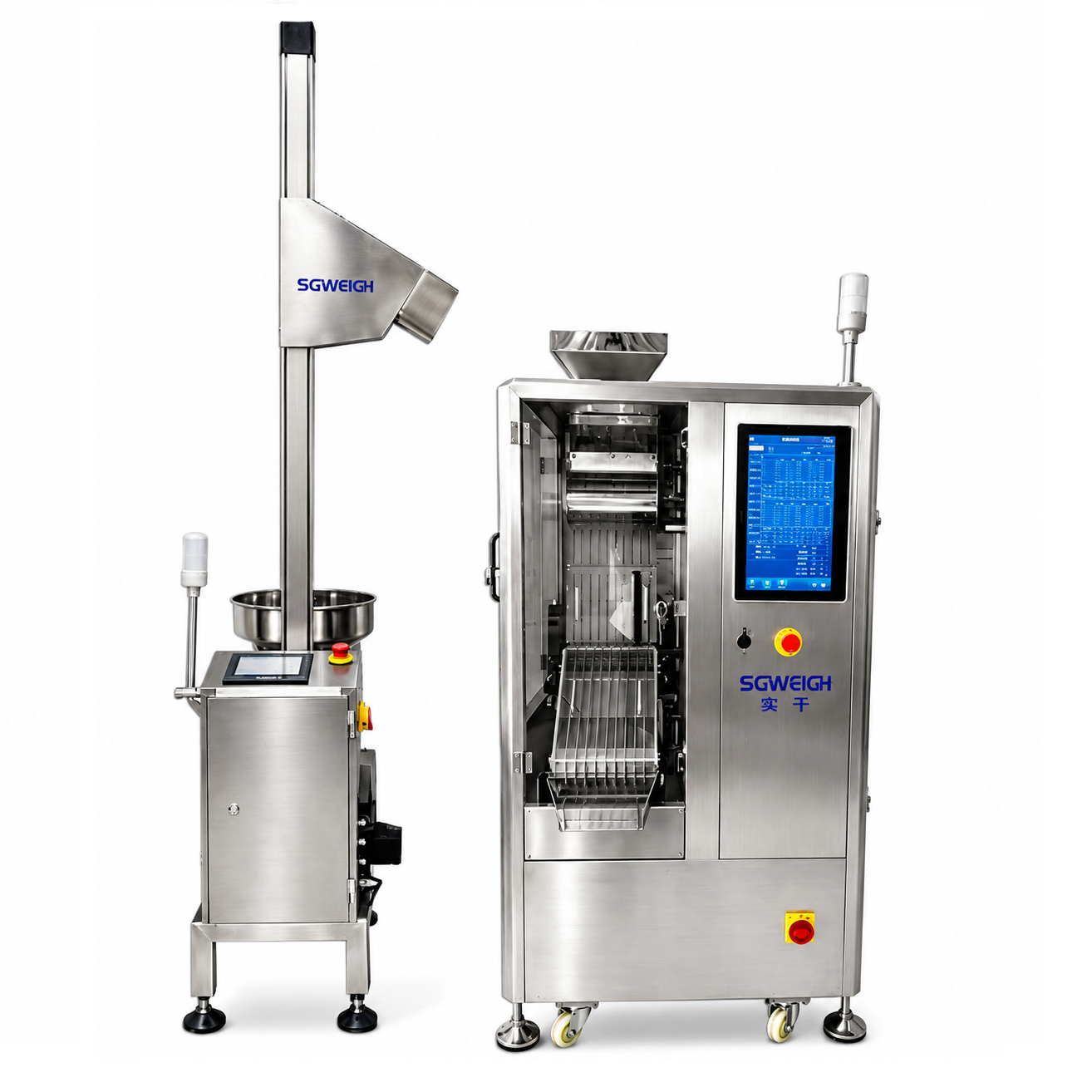
Therefore, an advanced capsule checkweigher should consider reject performance as a controlled parameter, not merely an accessory.
Depending on the design, rejection can be implemented through pneumatic, mechanical, air-blast, gate, flap or other mechanisms suitable for the capsule and production architecture.
The reject device should minimize:
- damage to acceptable capsules;
- carryover between lanes;
- cross-contamination between accepted and rejected products;
- missed rejects;
- unnecessary false rejects.
Why Are Data Integrity and Audit Trails Becoming Important in Capsule Checkweighing?
Modern inspection equipment increasingly operates as part of a digital production system.
The important question is no longer simply:
“What did the machine weigh?”
It also becomes:
“Who configured the limits, when were they changed, what was measured, and can the history be reconstructed?”
FDA states that data used in CGMP environments should be reliable and accurate and emphasizes risk-based controls for data integrity. FDA guidance describes the ALCOA principles of attributable, legible, contemporaneous, original and accurate records.
For computerized systems used in GMP-regulated activities, EU GMP Annex 11 similarly emphasizes validation, lifecycle management, risk management and data integrity.
This has direct implications for a modern capsule checkweigher.
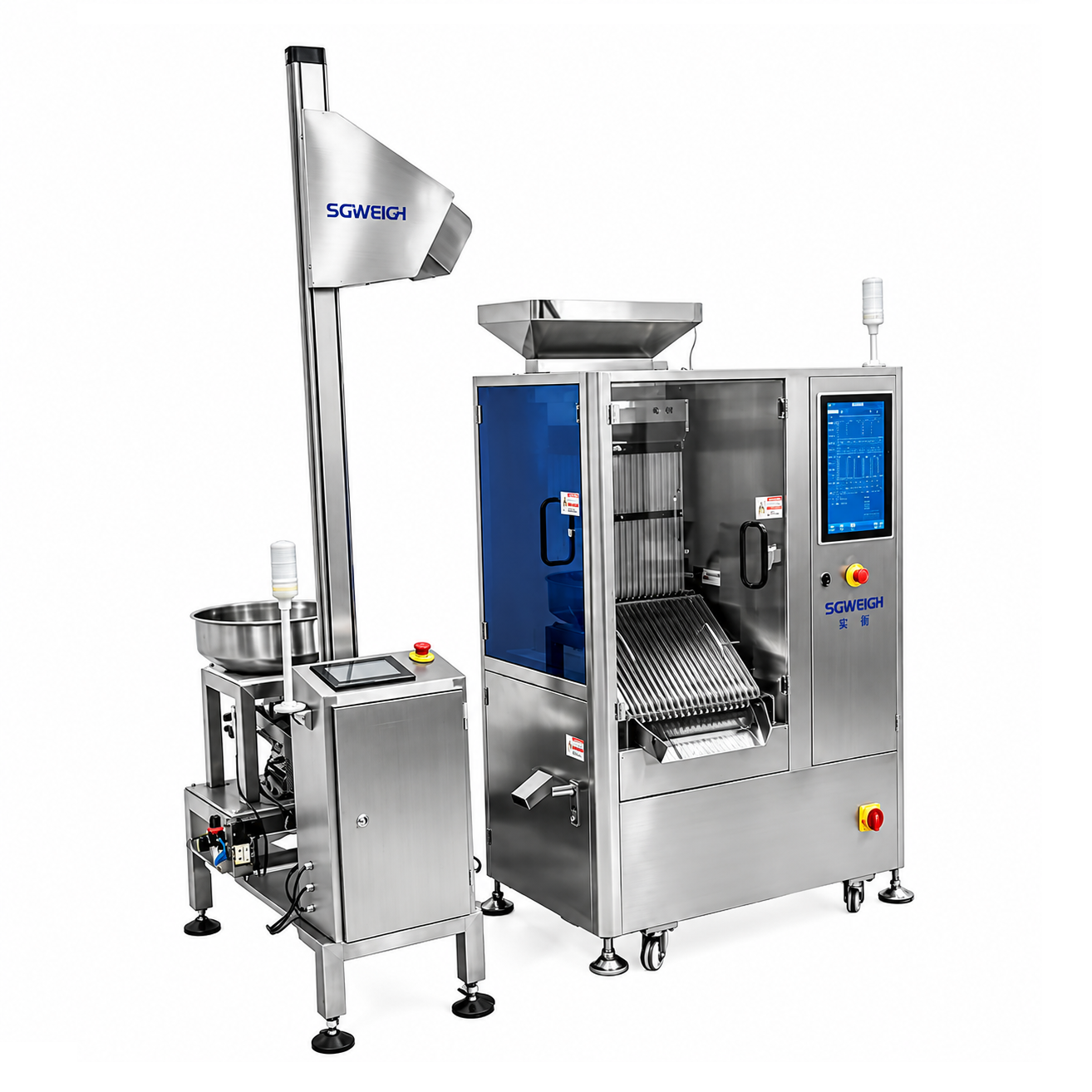
A production system may therefore incorporate functions such as:
User access control
Recipe management
Audit trail
Electronic records
Electronic signatures
Batch reports
Alarm history
Production statistics
Data export and backup
However, stating that a machine is “21 CFR Part 11 compliant” should not be treated as a substitute for system-level compliance assessment. Compliance depends on the actual computerized system, configuration, controls, validation and intended use.
What Should Engineers Check Before Purchasing a Hard Capsule Checkweigher?
A serious technical evaluation should start with the product rather than the machine brochure.
The supplier should understand:
Capsule size: e.g. 000, 00, 0, 1, 2, 3, 4 or 5
Typical capsule weight
Minimum and maximum product weight
Required weight tolerance
Required throughput
Number of lanes
Capsule dimensions and geometry
Expected reject rate
Available upstream/downstream equipment
Cleaning requirements
Data and traceability requirements
This information determines whether the appropriate architecture is a single-lane, multi-lane, 100% inspection or sampling-oriented configuration.
The correct specification is therefore not:
“What is the highest speed the machine can reach?”
It is:
“At the required production speed and with the actual capsule, what measurement performance and reject performance can be demonstrated?”
That is a far more meaningful engineering question.

Conclusion
How should a hard capsule checkweigher ultimately be judged?
Not by one impressive specification.
A genuinely high-performance system should demonstrate that it can maintain stable dynamic weighing, repeatable measurement, accurate product classification, reliable rejection and traceable data under actual production conditions.
For manufacturers, the most important evaluation criteria are therefore the complete system performance rather than sensor resolution alone.
Looking for a Hard Capsule Checkweigher?
Choosing the right hard capsule checkweigher requires more than comparing weighing accuracy or production speed. The capsule size, target weight, allowable tolerance, production capacity, number of lanes, product handling conditions, and required data functions all influence the final system configuration.
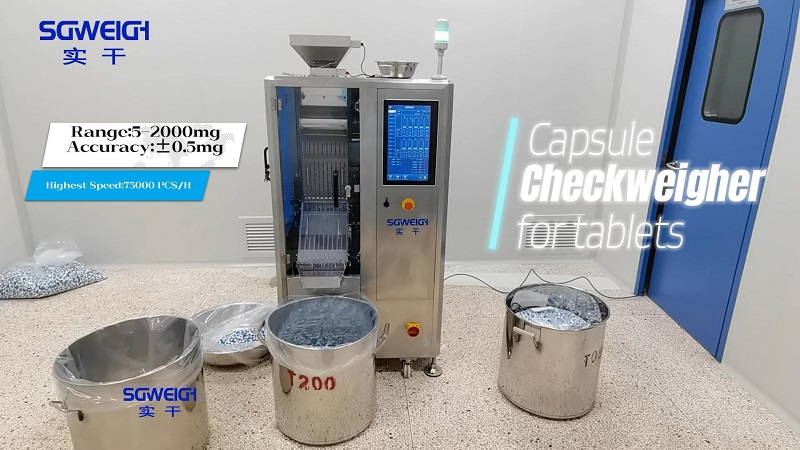
SGWEIGH provides high-speed hard capsule checkweighing solutions for automatic individual capsule weight inspection, including multi-lane configurations designed for high-throughput production environments. Our engineers can evaluate your capsule specifications and production requirements to recommend a suitable weighing and rejection system.
Whether you are looking for a Multi-lane hard capsule checkweigher, high-speed 100% capsule weight inspection, or a customized capsule weighing solution, our technical team can help you assess the appropriate configuration.
Contact SGWEIGH today to discuss your capsule checkweighing requirements and receive a technical solution tailored to your production line.

TAGS